
Difficulty swallowing with multiple sclerosis

Individuals with MS can experience weakness in muscles that are involved with breathing and coughing. A weak respiratory system can impair an individual’s ability to clear food or drink and protect their airway.

Symptoms

If you or a loved one are experiencing any of the following changes, it may be time to talk to your physician about getting a referral to see a speech-language pathologist.

  • Change in vocal quality after eating or drinking, with a wet or gurgly voice
  • Complaint of difficulty swallowing
  • Complaint of food sticking in throat
  • Coughing, choking, or clearing of the throat before, during, or after swallowing
  • Difficulty controlling food, liquids, or saliva in the  mouth
  • Drooling
  • Excessive chewing
  • Food getting stuck in the cheeks of your mouths
  • Nasal regurgitation
  • Needing  several shallow coughs in order to clear food or drink
  • Weight loss

Treatment

Treatment recommendations are based on the results of each person’s evaluation, with the shared goal of safe eating and drinking as independently as possible.

Modified food textures

Shepherd Center follows the standards of the International Dysphagia Diet Initiative (IDDSI):
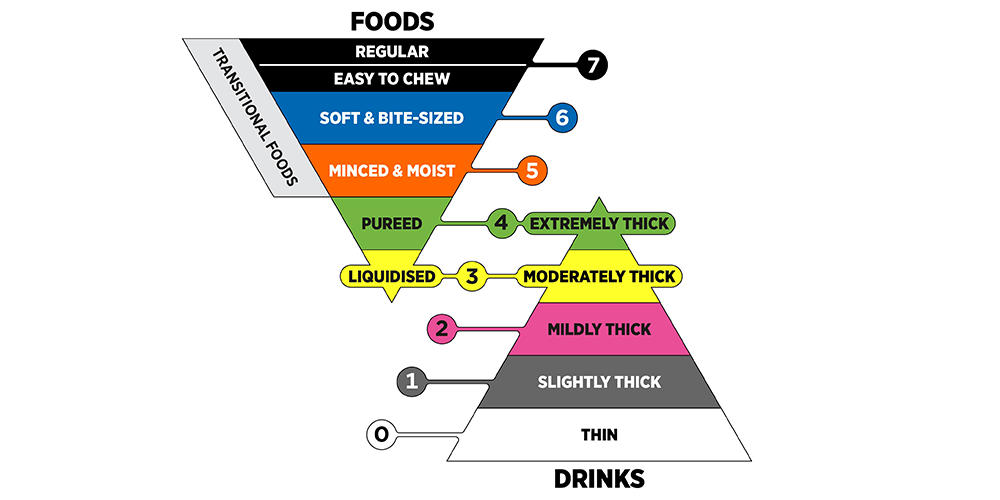
The International Dysphagia Diet Standardisation Initiative chart showing food and drink texture levels from thin drinks (level 0) to regular foods (level 7), with color-coded sections for each stage, including mildly, moderately, and extremely thick drinks, and various food textures.
© The International Dysphagia Diet Standardisation Initiative 2019 @ https://iddsi.org/

Level 1: Dysphagia pureed

  • Texture: Homogenous, very cohesive, pudding-like, requiring very little chewing ability
  • Examples: Cream of wheat, thinned grits, pureed or scrambled eggs, applesauce, smooth yogurt, pudding, Jell-O, strained soups, mashed potatoes, pureed vegetables, pureed fruits, pureed meats with gravy, ice cream, sherbet, and baby foods

Level 2: Dysphagia mechanical altered

  • Texture: Cohesive, moist, semi-solid foods, requiring some chewing
  • Examples: Thinned oatmeal, grits, cereal without nuts or dried fruits, scrambled or poached eggs, all yogurt, cottage cheese, soups without chunks, soft or fork-mashed vegetables, fork-mashed fruits, pasta, baked and mashed potatoes, baked fish, ground meats with gravy, cream pies, egg salad, fish salad, and all pureed foods

Level 3: Dysphagia advanced

  • Texture: Soft foods that require more chewing ability
  • Examples: All eggs, pancakes with syrup, french toast with syrup, canned fruits, soft cooked vegetables, salads, meat salads, chopped meats with gravy, rice with gravy, pasta, french fries, breads, pies, soft cookies, biscuits, rolls, and all foods on pureed and mechanical diets.
  • Exclusions: Hard raw vegetables, crisp fruits, fried meats or vegetables, nuts, seeds, and dried fruits

Level 4: Pureed

  • Texture: Blenderized or baby-food consistency, smooth with no lumps, cohesive, requires very little chewing ability
  • Examples: Mashed potatoes, applesauce, cream of wheat, yogurt, pudding

Level 5: Minced & moist

  • Texture: Meats are ground and mixed with sauce or gravy; solid foods are moist (may have sauce or gravy) and easily mashed with a fork; easily separates and comes through the fork
  • Examples: Ground turkey mixed with gravy

Level 6: Soft & bite sized

  • Texture: Meats are chopped or easily mashed; solid foods are moist and soft, bites are no bigger than 1.5cm x 1.5cm
  • Examples: Fish cooked soft enough to break into small pieces with a fork (no bones or tough skins), hamburger patty cut into 1.5cm x 1.5cm pieces

Level 7: Easy to chew

  • Texture: Normal, everyday foods of soft/ tender textures; can be cut and mashed with a fork or spoon; no hard, tough, chewy, or crunchy foods
  • Example: Cheese omelet, fish

Level 7: Regular

  • Texture: Normal, everyday foods of various textures; includes hard, tough, chewy, fibrous foods
  • Examples: Chicken on the bone, raw fruits and vegetables

Modified liquid textures

Level 0: Thin liquids

  • Regular liquids such as water, juice, and soft drinks

Level 1: Slightly thick

  • Naturally thicker liquids such as milk, Ensure, and ice cream

Level 2: Mildly thick

  • Liquids are thickened to the consistency of nectar juices

Level 3: Moderately thick

  • Liquids are thickened to the consistency of honey

Swallow precautions to reduce the risk of choking

  • Sit in an upright position (90 degrees) when eating and drinking.
  • Eat slowly.
  • Reduce distractions.
  • Make sure the mouth is clear completely between bites.
  • Take small bites and sips.
  • Remain in an upright, seated position for about 30 minutes after eating and drinking.
You're on Shepherd Center's patient education website. For our hospital's main website, please visit shepherd.org.