
Managing swallowing disorders after injury

Swallowing disorders, or dysphagia, can arise after damage to the nervous system from causes and conditions including stroke, brain and spinal cord injury, Parkinson’s disease, multiple sclerosis, muscular dystrophy, cerebral palsy, and Alzheimer’s disease.

Common symptoms include:

  • Coughing or throat-clearing during or right after eating or drinking
  • Gurgling sounds during or after eating and drinking
  • Watery eyes or runny nose during eating and drinking
  • Multiple swallows seen for every bite or sip
  • Shortness of breath when eating or drinking
  • Food or liquid escaping from the mouth or becoming stuck in the mouth
  • Recurring pneumonia or chest congestion
  • Weight loss or dehydration from not being able to eat enough

Dysphagia may result in poor nutrition or dehydration, aspiration, pneumonia, less enjoyment of eating and drinking, and embarrassment or isolation in social situations centered around eating. Aspiration, either with or without symptoms, occurs when food or liquid enter the airway below the level of the vocal cords.

Diagnosis

Difficulties can occur when food or liquid are in the mouth, throat, or esophagus during the swallowing process. A speech-language pathologist (SLP) can help diagnose the issue.

  • Bedside swallow evaluation: A process used by the SLP to examine the patient’s swallow and evaluate the overt signs and symptoms of aspiration.
  • Modified barium swallow study: The individual eats and drinks food or liquid with barium in it for the SLP to view the swallow process under X-ray.
  • Endoscopic assessment: A lighted scope is put in the nose to the level of the throat and the swallow process is then viewed on a screen.

Communicate with your SLP about ongoing changes and strategies related to swallow safety. As treatment progresses, diet consistencies will change. Ask questions.

Treatment

Treatment recommendations are based on the results of each person’s evaluation, with the shared goal of safe eating and drinking as independently as possible.

Modified food textures

Shepherd Center follows the standards of the International Dysphagia Diet Initiative (IDDSI):
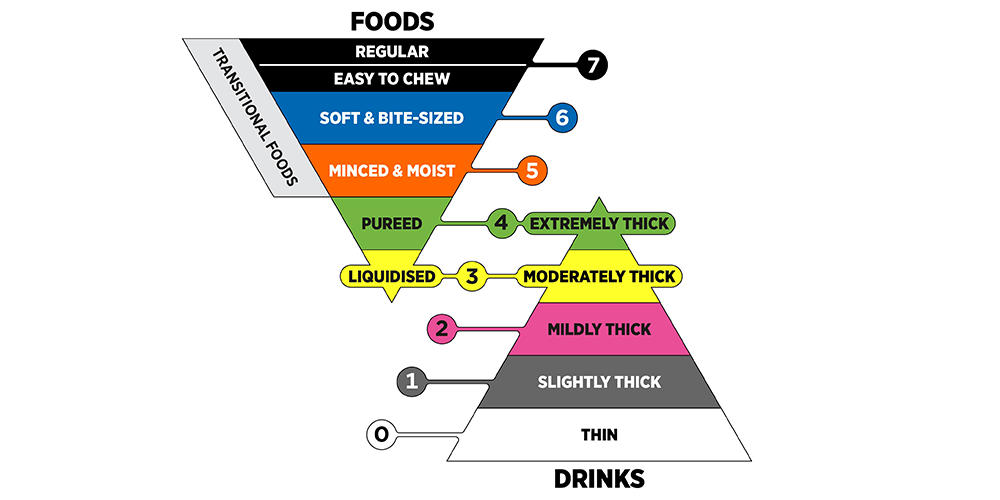
The International Dysphagia Diet Standardisation Initiative chart showing food and drink texture levels from thin drinks (level 0) to regular foods (level 7), with color-coded sections for each stage, including mildly, moderately, and extremely thick drinks, and various food textures.
© The International Dysphagia Diet Standardisation Initiative 2019 @ https://iddsi.org/

Level 1: Dysphagia pureed

  • Texture: Homogenous, very cohesive, pudding-like, requiring very little chewing ability
  • Examples: Cream of wheat, thinned grits, pureed or scrambled eggs, applesauce, smooth yogurt, pudding, Jell-O, strained soups, mashed potatoes, pureed vegetables, pureed fruits, pureed meats with gravy, ice cream, sherbet, and baby foods

Level 2: Dysphagia mechanical altered

  • Texture: Cohesive, moist, semi-solid foods, requiring some chewing
  • Examples: Thinned oatmeal, grits, cereal without nuts or dried fruits, scrambled or poached eggs, all yogurt, cottage cheese, soups without chunks, soft or fork-mashed vegetables, fork-mashed fruits, pasta, baked and mashed potatoes, baked fish, ground meats with gravy, cream pies, egg salad, fish salad, and all pureed foods

Level 3: Dysphagia advanced

  • Texture: Soft foods that require more chewing ability
  • Examples: All eggs, pancakes with syrup, french toast with syrup, canned fruits, soft cooked vegetables, salads, meat salads, chopped meats with gravy, rice with gravy, pasta, french fries, breads, pies, soft cookies, biscuits, rolls, and all foods on pureed and mechanical diets.
  • Exclusions: Hard raw vegetables, crisp fruits, fried meats or vegetables, nuts, seeds, and dried fruits

Level 4: Pureed

  • Texture: Blenderized or baby-food consistency, smooth with no lumps, cohesive, requires very little chewing ability
  • Examples: Mashed potatoes, applesauce, cream of wheat, yogurt, pudding

Level 5: Minced & moist

  • Texture: Meats are ground and mixed with sauce or gravy; solid foods are moist (may have sauce or gravy) and easily mashed with a fork; easily separates and comes through the fork
  • Examples: Ground turkey mixed with gravy

Level 6: Soft & bite sized

  • Texture: Meats are chopped or easily mashed; solid foods are moist and soft, bites are no bigger than 1.5cm x 1.5cm
  • Examples: Fish cooked soft enough to break into small pieces with a fork (no bones or tough skins), hamburger patty cut into 1.5cm x 1.5cm pieces

Level 7: Easy to chew

  • Texture: Normal, everyday foods of soft/ tender textures; can be cut and mashed with a fork or spoon; no hard, tough, chewy, or crunchy foods
  • Example: Cheese omelet, fish

Level 7: Regular

  • Texture: Normal, everyday foods of various textures; includes hard, tough, chewy, fibrous foods
  • Examples: Chicken on the bone, raw fruits and vegetables

Modified liquid textures

Level 0: Thin liquids

  • Regular liquids such as water, juice, and soft drinks

Level 1: Slightly thick

  • Naturally thicker liquids such as milk, Ensure, and ice cream

Level 2: Mildly thick

  • Liquids are thickened to the consistency of nectar juices

Level 3: Moderately thick

  • Liquids are thickened to the consistency of honey

Swallow precautions to reduce the risk of choking

  • Sit in an upright position (90 degrees) when eating and drinking.
  • Eat slowly.
  • Reduce distractions.
  • Make sure the mouth is clear completely between bites.
  • Take small bites and sips.
  • Remain in an upright, seated position for about 30 minutes after eating and drinking.
You're on Shepherd Center's patient education website. For our hospital's main website, please visit shepherd.org.